
Right now: Tucson is at 44, good.
Is the air safe to breathe in Tucson today?
In Tucson, BreatheCheck reads 44 as Go. The cutoffs: go below 101, keep it short and easy from 101 to 150, move it indoors above 150. These are our own thresholds, drawn on the EPA bands — EPA itself classifies 101–150 as Unhealthy for Sensitive Groups and does not tell you how long to stay out.
Go AQI 0–100
Normal outdoor plans. No change needed.
Short & unloaded AQI 101–150
A 20-minute dog walk, not a 2.5-hour run. Keep it brief and easy.
Don’t go AQI 151+
Move it indoors. Above 200 that becomes everyone, not just sensitive groups.
Above 200 this stops being a personal call: everyone indoors.
Duration and intensity are two separate dials
| Under 20 min | 20–60 min | Over an hour | |
|---|---|---|---|
| Easy | Go | Go | Go |
| Moderate | Go | Go | Go |
| Hard | Go | Go | Go |
Go Every combination lands the same way at this reading — a hard hour is no different from an easy twenty minutes. The two dials separate above 80.
Where people actually draw the line
All the thresholds people reported, and who reported them
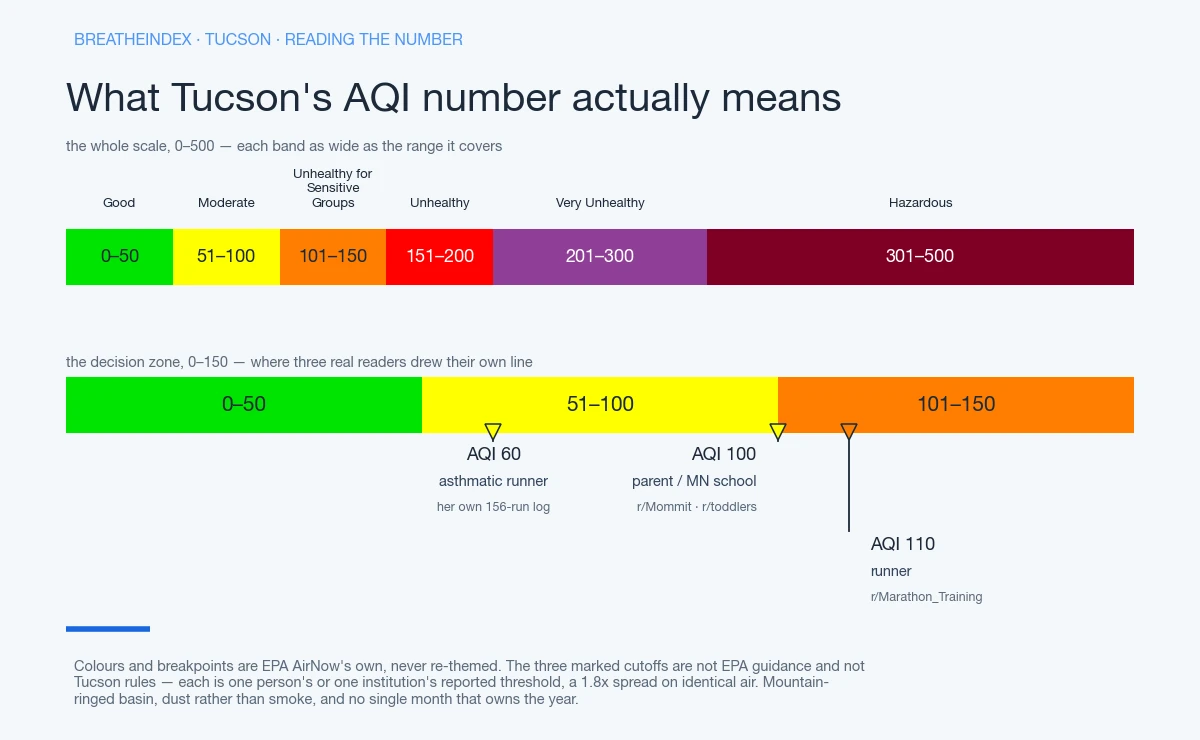
- 60 Asthmatic runnerone runner’s own 156-run log
- 75–100 Daycare / schoolparents and staff in one r/toddlers thread, Aug 2025 — not a published rule
- 100 Parentcommunity-reported, escalating at 150 and 200
- 110 Runnercommunity-reported
If you’re staying in, filter the room you’re actually in
That reading and color are today’s Tucson call, nothing more. It decides the Sabino Canyon hike, the kid’s soccer practice, or whether the windows stay open tonight. BreatheCheck tracks the air quality Tucson has actually breathed since we began measuring here, not just the number above. Set your own line and an email arrives when monsoon dust pushes past it.
How does today compare with Tucson’s record so far?
Since 16 August 2026 we have recorded 30 days for Tucson. 1 went above AQI 100, and the highest daily maximum was 161, on 18 August 2026. The day-by-day record is further down.
Today’s number alone can’t separate an ordinary week from a dust event. Our own record, further down this page, rebuilds the air quality Tucson has seen since we began measuring here, from the same hourly AQI feed as the number above.
The page also carries a running count of days above AQI 100 since we began counting. IQAir, AccuWeather, aqicn and Arizona’s own monitor grid show today’s number and stop there. A dust-storm day that clears by the next morning still shows up here instead of disappearing.
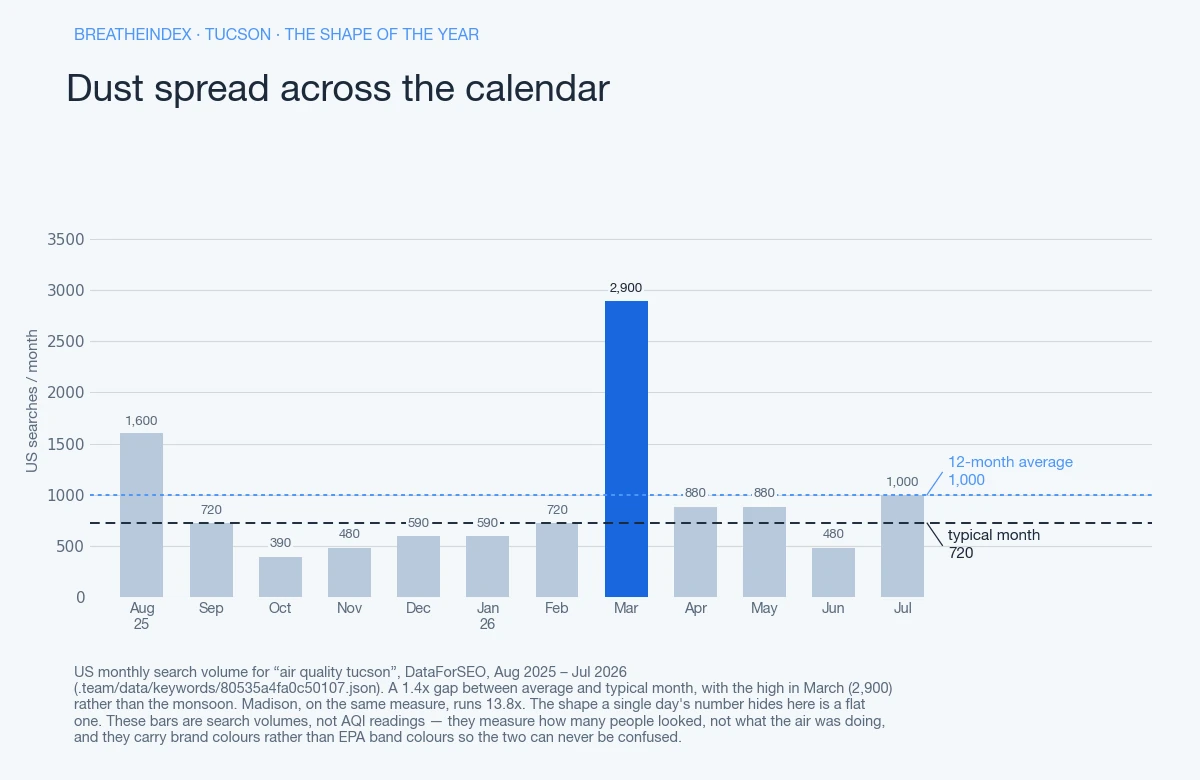
Tucson’s own search demand hints at why that history matters more here than in a smoke-driven metro. Averaged across the trailing year it runs 1,000 a month, against a typical month of 720. That’s a 1.4x gap between the average and the typical month. Madison, on the same average-to-typical measure, runs 13.8x, because one Canadian smoke month carries its whole year. Tucson’s dust is spread across the calendar instead, which is exactly the shape a single day’s number hides.
Why is it hazy in Tucson today?
Three things can make Tucson’s sky look worse than the number reads. The AQI smooths recent hours together, weighted toward the latest, so one dusty hour takes a few hours to show up in full. Monsoon dust is also patchy — a wall of it can wrap one side of the basin and miss a neighborhood a few miles off. And the nearest station may sit far from wherever a person is standing.
A calm reading downtown says less about Marana or the east side than it looks like it does. None of that makes the haze fake — one number averages one location, not your block. Monsoon dust and the ozone behind it covers every way a reading and your senses split.
What is causing the bad air in Tucson?
The air quality Tucson sees each summer runs on the same monsoon system Phoenix sits in, but the dust doesn’t behave identically in each city. Phoenix’s valley is wide and flat enough for a haboob to cross in one long wall. Tucson’s basin is smaller and more mountain-ringed — Santa Catalinas north, Rincons east, Santa Ritas south, Tucson Mountains west.
A Tucson dust wall generally runs into higher ground sooner — reasoned from geography, not measured; nobody publishes a haboob-length figure for either city. Both cities share the pollutant itself: coarse, wind-lofted PM10 particulate matter, not the fine PM2.5 that dominates wildfire smoke.
Winter runs on a separate mechanism. The same mountains trap cool air near the ground on cold, still nights — a thermal inversion, the mechanism behind Denver’s brown cloud. It holds wood smoke and exhaust down instead of letting them disperse. We haven’t found Tucson-specific reporting on the winter pattern, so this is the general basin mechanism, not a sourced local account.
What makes the call different in Tucson?
A Tucson monsoon dust wall can wrap Marana and miss a neighborhood on the east side entirely. The citywide number can read calmer than what’s actually blowing past a person’s own window. Go on ordinary air. Short and unloaded: the short version of the Sabino Canyon loop instead of the full wash. Don’t go once dust pushes the reading into red.
EPA’s everyone-warning starts at 151, Unhealthy, and 201 to 300, Very Unhealthy, is that same warning at a more serious level, not a new group. Past roughly 200, dust wall or clear side of town, the plan moves indoors.
What AQI should you stay inside?
- That’s one runner’s ceiling, from r/Marathon_Training: “I’ll run in up to 110 because…error bars.” 60 is another number entirely — an asthmatic runner’s, from 156 logged runs against AQI. Past it, “my lungs struggle regardless of how well I’ve trained,” even though EPA calls nothing under 100 unhealthy. Their success rate: 87% under 50, 42% between 50–70, 12% past 70. Parents land near 100.
Dust clears fast; smoke doesn’t. A Tucson monsoon wall and a wildfire-smoke event shift the numbers above by different amounts — smoke drags the table down further, about one EPA band. EPA’s category reads 101–150, Unhealthy for Sensitive Groups — attributed, not a verdict on any one reader.
No Arizona rule sets a school or daycare AQI cutoff, at least not one this project has confirmed. Washington’s and Minnesota’s are the only two documented numbers anywhere in the material reviewed. The numbers reported from two states, and what they are has both. Ask your own provider what they actually use.
A portable HEPA unit, or a Corsi-Rosenthal box built for roughly $130 in a 12x14 bedroom, is the safer indoor call. Leave the whole-house MERV-13 filter alone until a licensed tech checks the static pressure — an undersized system won’t forgive the swap. What to run indoors when the dust arrives has the setup.
Why our number may not match what you are seeing and smelling
Ground-level ozone is invisible and odorless wherever it forms, Tucson included. On a clear, still summer afternoon the reading can run higher than the sky suggests — the same gap that shows up in Phoenix, Denver and Los Angeles. There’s no smelling your way to a safe read on it.
The reverse also happens, on a shorter clock than most expect. A morning hazy from an overnight inversion can read moderate by noon, once the average smooths the spike and the sun burns the inversion off. Checking once, at the wrong hour, gives a different picture than the day actually had.
There’s a third case the AQI doesn’t help with at all: Valley Fever. Coccidioides, the fungus behind it, is endemic across the Sonoran Desert basin, Tucson included. It rides into the air on wind and disturbed dust, independent of whatever the PM2.5 or PM10 numbers say. The AQI does not measure fungal spores at any level; our own methodology page states that plainly. Arizona’s Department of Health Services publishes its own guidance on dust, air quality and Valley Fever specifically — that’s the source to check, not this page.
Today’s reading for Tucson comes from AirNow’s Tucson reporting area, whose reference point sits about 4.3 miles from the metro centre. As of .
A station miles off under-reports whichever side of the basin sits farthest from it. That’s worst during a monsoon storm the station on the other side never saw. Why a monsoon cell the station never saw still counts goes through it.
Phoenix sits in the same Desert Southwest haboob and monsoon airshed, and so does Albuquerque, further up the same corridor.
Where this number sits
Of the 121 US metros reporting to us right now, Tucson is number 46 and number 2 of the 3 we track in Arizona. The pollutant driving it today is O3.
Nearby metros we also measure, and what they read at the same hour:
- Scottsdale, AZ — 104 miles away, AQI 37
- Phoenix, AZ — 106 miles away, AQI 66
- Las Cruces, NM — 245 miles away, AQI 49
- Albuquerque, NM — 317 miles away, AQI 50
Where this reading comes from
AirNow’s Tucson reporting area, about 4.3 miles from the metro centre.
What has air quality in Tucson actually been?
1 of the 30 days we have recorded so far went above AQI 100.
| Date | Daily max AQI | EPA band | Hours read |
|---|---|---|---|
| 49 | Good | 23 | |
| 52 | Moderate | 23 | |
| 53 | Moderate | 24 | |
| 55 | Moderate | 23 | |
| 79 | Moderate | 24 | |
| 44 | Good | 23 | |
| 45 | Good | 24 | |
| 95 | Moderate | 23 | |
| 57 | Moderate | 23 | |
| 49 | Good | 23 | |
| 48 | Good | 24 | |
| 51 | Moderate | 24 | |
| 56 | Moderate | 24 | |
| 58 | Moderate | 23 | |
| 67 | Moderate | 23 | |
| 67 | Moderate | 23 | |
| 93 | Moderate | 24 | |
| 77 | Moderate | 23 | |
| 80 | Moderate | 23 | |
| 84 | Moderate | 23 | |
| 93 | Moderate | 23 | |
| 74 | Moderate | 24 | |
| 61 | Moderate | 23 | |
| 97 | Moderate | 24 | |
| 97 | Moderate | 24 | |
| 77 | Moderate | 24 | |
| 77 | Moderate | 23 | |
| 161 | Unhealthy | 24 | |
| 74 | Moderate | 27 | |
| 67 | Moderate | 13 — partial day |
Questions about Tucson
What is the air quality in Tucson right now?
Which monitor does this number come from?
How does Tucson compare with metros nearby?
Does this include pollen?
Put this number in context
Updated