
Right now: Los Angeles is at 60, moderate.
Is the air safe to breathe in Los Angeles today?
In Los Angeles, BreatheCheck reads 60 as Go. The cutoffs: go below 101, keep it short and easy from 101 to 150, move it indoors above 150. These are our own thresholds, drawn on the EPA bands — EPA itself classifies 101–150 as Unhealthy for Sensitive Groups and does not tell you how long to stay out.
Go AQI 0–100
Normal outdoor plans. No change needed.
Short & unloaded AQI 101–150
A 20-minute dog walk, not a 2.5-hour run. Keep it brief and easy.
Don’t go AQI 151+
Move it indoors. Above 200 that becomes everyone, not just sensitive groups.
Above 200 this stops being a personal call: everyone indoors.
Duration and intensity are two separate dials
| Under 20 min | 20–60 min | Over an hour | |
|---|---|---|---|
| Easy | Go | Go | Go |
| Moderate | Go | Go | Go |
| Hard | Go | Go | Go |
Go Every combination lands the same way at this reading — a hard hour is no different from an easy twenty minutes. The two dials separate above 80.
Where people actually draw the line
At 60, this reading is past Asthmatic runner 's line.
All the thresholds people reported, and who reported them
- 60 Asthmatic runnerone runner’s own 156-run log
- 75–100 Daycare / schoolparents and staff in one r/toddlers thread, Aug 2025 — not a published rule
- 100 Parentcommunity-reported, escalating at 150 and 200
- 110 Runnercommunity-reported
If you’re staying in, filter the room you’re actually in
That reading is today’s call on Los Angeles air quality — the color first, the number right behind it. What it’s actually deciding is smaller than the headline: the beach run, the kid’s soccer practice, whether the windows stay open tonight. BreatheCheck tracks the air quality Los Angeles has actually breathed since we began measuring here, not the one figure refreshing above. Skip refreshing it yourself — an email the moment the basin crosses your number does it for you.
How does today compare with Los Angeles’s record so far?
Since 16 August 2026 we have recorded 30 days for Los Angeles. 9 went above AQI 100, and the highest daily maximum was 161, on 26 August 2026. The day-by-day record is further down.
One reading tells you nothing about the shape behind it. This rebuilds the air quality Los Angeles saw since we began measuring here from the same hourly AQI feed as the number above.
The page also carries a running count of days above AQI 100 since we began counting. IQAir, AccuWeather, aqicn and the South Coast basin’s own monitor grid hand you today’s figure and stop there. None renders the metro’s shape over time. Los Angeles runs closer to the ozone-dominant profile it shares with Denver, Houston, Atlanta and Phoenix than to a single winter smear. Afternoon spikes on hot, still days spread across summer and early fall — not one cold-season stretch. A bad Tuesday that clears by Thursday still shows up here.
Why is it hazy in Los Angeles today?
Los Angeles sits in a basin ringed by the San Gabriel and San Bernardino mountains. A marine layer off the Pacific holds pollution near the ground. Three things can make the sky look worse than the reading. The AQI averages 24 hours, diluting a rough afternoon. Smoke from an active fire can sit aloft above the monitor. Or the nearest station can sit miles off, in a metro that runs coast to Inland Empire.
The Port of LA/Long Beach complex adds near-constant vehicle traffic to what the basin can’t drain on its own. Santa Ana winds are the exception — offshore gusts that can scour the haze out to sea in hours, and also the wind behind the region’s worst wildfires. None of that makes the haze fake — one number averages one location, not your block. Smog that photographs and ozone that doesn’t covers all six causes.
What is causing the bad air in Los Angeles?
Two mechanisms wear the same number in Los Angeles, and the season tells you which one you’re in. In summer, ground-level ozone dominates: sunlight cooks vehicle exhaust into a pollutant that peaks on hot, still afternoons, often worse inland than along the beach. Wildfire smoke is the exception that resets everything, pushing fine particulate matter (PM2.5) readings high on top of the ozone baseline.
It’s why Los Angeles sits in the same ozone-dominant bracket as Denver, Houston, Atlanta and Phoenix. The AQI can post a moderate number while the ozone component specifically is still doing damage. On September 11, 2020, the Bobcat Fire was still burning. One commenter’s running total for that day: “already at 26,000 acres and really not at all contained.” A widely shared Los Angeles Times photo — a raven silhouetted against a Garden Grove sky, credited to Allen J. Schaben — carried the caption: air quality officials had double-checked their monitoring equipment for errors. That’s fine particulate matter (PM2.5), not ozone — visible, a different mechanism from the invisible gas doing the damage on a clear afternoon.
What makes the call different in Los Angeles?
Los Angeles sits in a basin walled in on three sides by the San Gabriel and San Bernardino ranges. A marine layer holds pollution close to the ground most days. Go, unchanged, on Good or Moderate air. Short and unloaded: the porch stretch instead of the full workout. Don’t go past that.
The exception is a Santa Ana wind event, which can scour the whole basin clear in hours — or push a wildfire the other direction. EPA’s warning to everyone opens at 151, Unhealthy. 201 to 300, Very Unhealthy, is that same warning turned up rather than a new group entering it. Past roughly 200, the basin isn’t clearing on its own.
What AQI should you stay inside?
No California daycare or school AQI rule turned up in the material reviewed here. The only numbers this project found, for Washington and Minnesota, are individual accounts of single centres rather than state rules. Which states document a daycare cutoff covers both.
Santa Ana winds pull every personal threshold down when they’re carrying wildfire smoke instead of simply clearing the basin. EPA files that window under 101–150, Unhealthy for Sensitive Groups — their classification, not a ruling on your lungs.
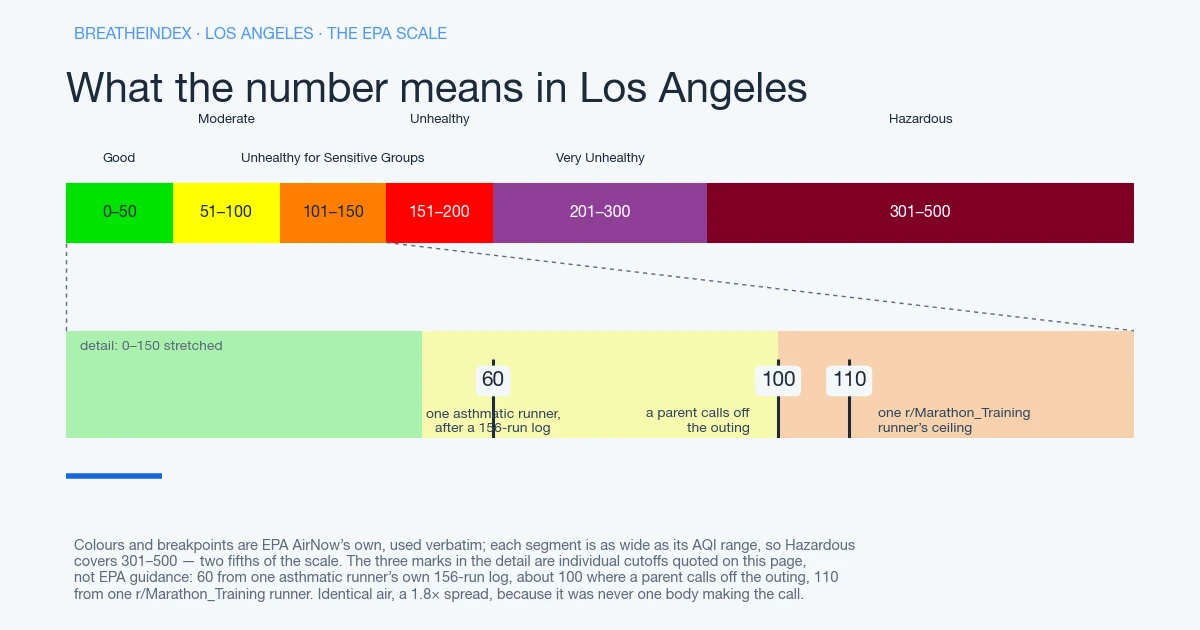
Individual numbers run well under that EPA line regardless of wind direction. An asthmatic runner logged 156 runs against AQI and drew a hard ceiling at 60. Past it, “my lungs struggle regardless of how well I’ve trained,” though EPA calls nothing under 100 unhealthy. That log: 87% of runs under 50 went fine, 42% between 50 and 70, just 12% past 70. A r/Marathon_Training runner sets theirs nearly double: “I’ll run in up to 110 because…error bars.” Parents online tend to land near 100.
Indoors, default to a portable HEPA purifier or a Corsi-Rosenthal box, priced by one community builder at $130 for a 12x14 bedroom. A whole-house MERV-13 swap needs a static-pressure check from a licensed tech first — it isn’t the automatic choice in a basin this size. The indoor setup, lever by lever covers the rest.
Why our number may not match what you are seeing and smelling
This cuts two directions, and the second is the one nobody warns you about.
Direction one: the sky looks clear, the number is bad. Ground-level ozone, the dominant summer pollutant here, is invisible and odorless. A bright, still afternoon with no visible haze can still carry an AQI in the 100s. There’s no smelling your way to a safe read on it; you have to check the number.
Direction two: the sky is wrong, and the official line stays surprisingly calm. In January 2025, days after that month’s fires, one runner training for the LA Marathon moved to the treadmill: “the air quality is horrendous… there’s so many chemicals in the air right now. I’m not trying to inhale asbestos on a daily basis.” The AQI is built from six pollutants — PM2.5, PM10, ozone, NO2, SO2 and CO. Asbestos, lead and the VOCs a burning structure releases aren’t part of that number. A moderate reading during a structure fire describes those six pollutants, not everything in the smoke. A different resident voiced the same doubt during a June 2026 urban fire that led the governor to declare a state of emergency: “Anyone else remember yesterday when the fire chief said there’s nothing harmful in the air unless you’re particularly sensitive to smoke? I remember.”
Today’s reading for Los Angeles comes from AirNow’s Central LA CO reporting area, whose reference point sits about 1.4 miles from the metro centre. As of .
A station miles off under-reports whichever side of the sprawling basin sits farthest from it. How one station stands in for a basin this size explains the limits.
Why Los Angeles’s smog got better — and what didn’t
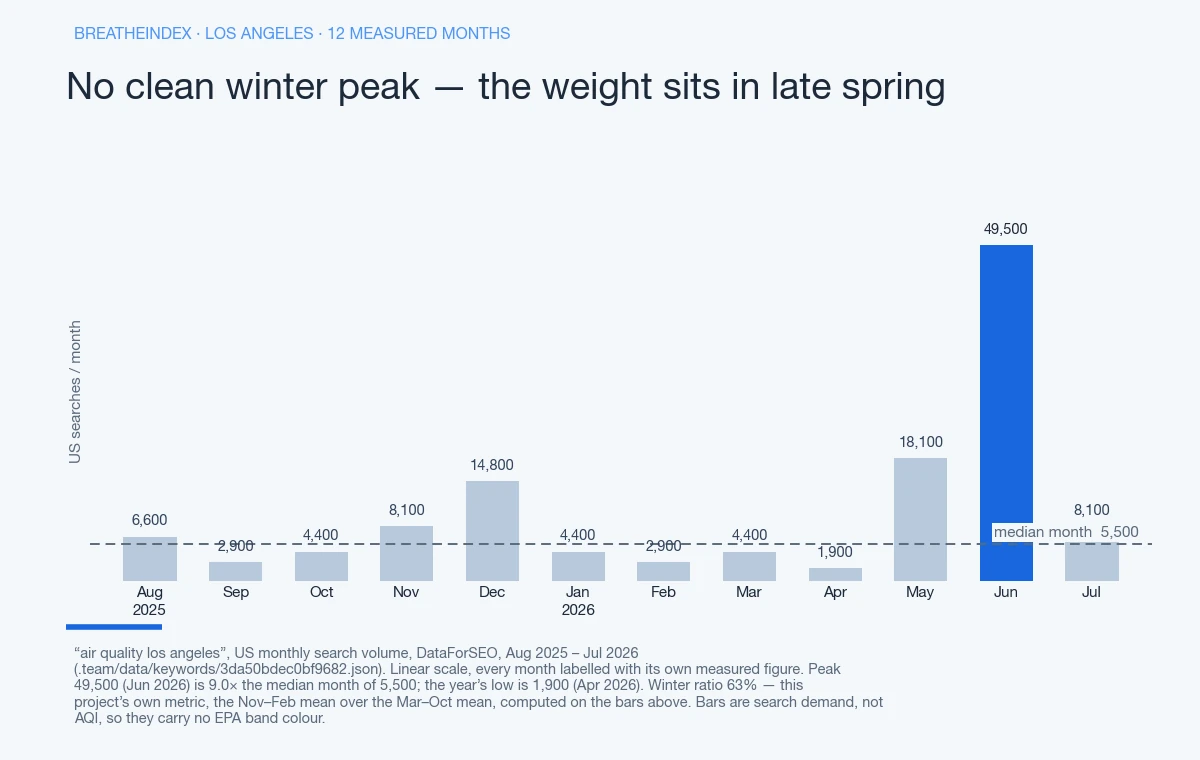
Los Angeles’s smog has genuinely dropped over decades of cleaner cars and tighter exhaust rules. Search interest still spikes once a year. A June 2026 high of 49,500 ran 9.0 times the 5,500 median month. Worst days concentrate in summer and early-fall ozone season, plus whatever wildfire smoke a given year brings.
Search interest for air quality Los Angeles doesn’t split into two clean seasonal peaks the way a snow-belt city’s does. “I can still remember the smoggy days that we would have in the summer,” one longtime resident wrote — smog as something Angelenos now talk about in the past tense.
During the 2020 pandemic lockdown, with traffic down and skies unusually clear, one hiker wrote: “I was hiking across from the Getty a few days back and could see Catalina and downtown Long Beach. It was unreal.” A second commenter spelled out why that mattered: “Catalina from the Getty yes, but not LGB. That must have been amazing.” Catalina from the Getty is a sight regulars already know. Long Beach visible alongside it wasn’t. A third commenter, from Mount Washington instead, reported the same extended reach: “You can see Catalina and LB from the top of Mt Washington right now… Absolutely unreal.” Catalina works as a folk indicator precisely because it isn’t a number — anyone can check it without an app.
Ozone hasn’t followed the same line down. It puts Los Angeles in the same bracket as metros where the AQI reads moderate while ozone alone is still doing damage. Long Beach shares this basin and its port traffic, and Irvine catches the same marine layer inland. Further out, the same mechanism, not the same geography, drives Denver’s identical “moderate but not really” read, along with Houston’s refinery-driven ozone, Atlanta’s summer season and Phoenix’s heat-cooked spikes.
Where this number sits
Of the 121 US metros reporting to us right now, Los Angeles is number 10 and number 4 of the 12 we track in California. The pollutant driving it today is PM2.5.
Nearby metros we also measure, and what they read at the same hour:
- Long Beach, CA — 20 miles away, AQI 50
- Anaheim, CA — 24 miles away, AQI 46
- Irvine, CA — 35 miles away, AQI 46
- Riverside, CA — 49 miles away, AQI 73
Where this reading comes from
AirNow’s Central LA CO reporting area, about 1.4 miles from the metro centre.
What has air quality in Los Angeles actually been?
9 of the 30 days we have recorded so far went above AQI 100.
| Date | Daily max AQI | EPA band | Hours read |
|---|---|---|---|
| 61 | Moderate | 23 | |
| 62 | Moderate | 24 | |
| 65 | Moderate | 24 | |
| 71 | Moderate | 24 | |
| 67 | Moderate | 24 | |
| 93 | Moderate | 24 | |
| 52 | Moderate | 24 | |
| 52 | Moderate | 24 | |
| 80 | Moderate | 24 | |
| 62 | Moderate | 25 | |
| 50 | Good | 24 | |
| 55 | Moderate | 24 | |
| 57 | Moderate | 24 | |
| 63 | Moderate | 24 | |
| 69 | Moderate | 24 | |
| 77 | Moderate | 24 | |
| 115 | Unhealthy for Sensitive Groups | 24 | |
| 122 | Unhealthy for Sensitive Groups | 24 | |
| 129 | Unhealthy for Sensitive Groups | 24 | |
| 161 | Unhealthy | 24 | |
| 101 | Unhealthy for Sensitive Groups | 24 | |
| 80 | Moderate | 24 | |
| 119 | Unhealthy for Sensitive Groups | 24 | |
| 108 | Unhealthy for Sensitive Groups | 24 | |
| 122 | Unhealthy for Sensitive Groups | 24 | |
| 93 | Moderate | 24 | |
| 119 | Unhealthy for Sensitive Groups | 24 | |
| 65 | Moderate | 24 | |
| 56 | Moderate | 27 | |
| 44 | Good | 13 — partial day |
Questions about Los Angeles
What is the air quality in Los Angeles right now?
Which monitor does this number come from?
How does Los Angeles compare with metros nearby?
Does this include pollen?
Put this number in context
Updated