
Right now: Denver is at 44, good.
Is the air safe to breathe in Denver today?
In Denver, BreatheCheck reads 44 as Go. The cutoffs: go below 101, keep it short and easy from 101 to 150, move it indoors above 150. These are our own thresholds, drawn on the EPA bands — EPA itself classifies 101–150 as Unhealthy for Sensitive Groups and does not tell you how long to stay out.
Go AQI 0–100
Normal outdoor plans. No change needed.
Short & unloaded AQI 101–150
A 20-minute dog walk, not a 2.5-hour run. Keep it brief and easy.
Don’t go AQI 151+
Move it indoors. Above 200 that becomes everyone, not just sensitive groups.
Above 200 this stops being a personal call: everyone indoors.
Duration and intensity are two separate dials
| Under 20 min | 20–60 min | Over an hour | |
|---|---|---|---|
| Easy | Go | Go | Go |
| Moderate | Go | Go | Go |
| Hard | Go | Go | Go |
Go Every combination lands the same way at this reading — a hard hour is no different from an easy twenty minutes. The two dials separate above 80.
Where people actually draw the line
All the thresholds people reported, and who reported them
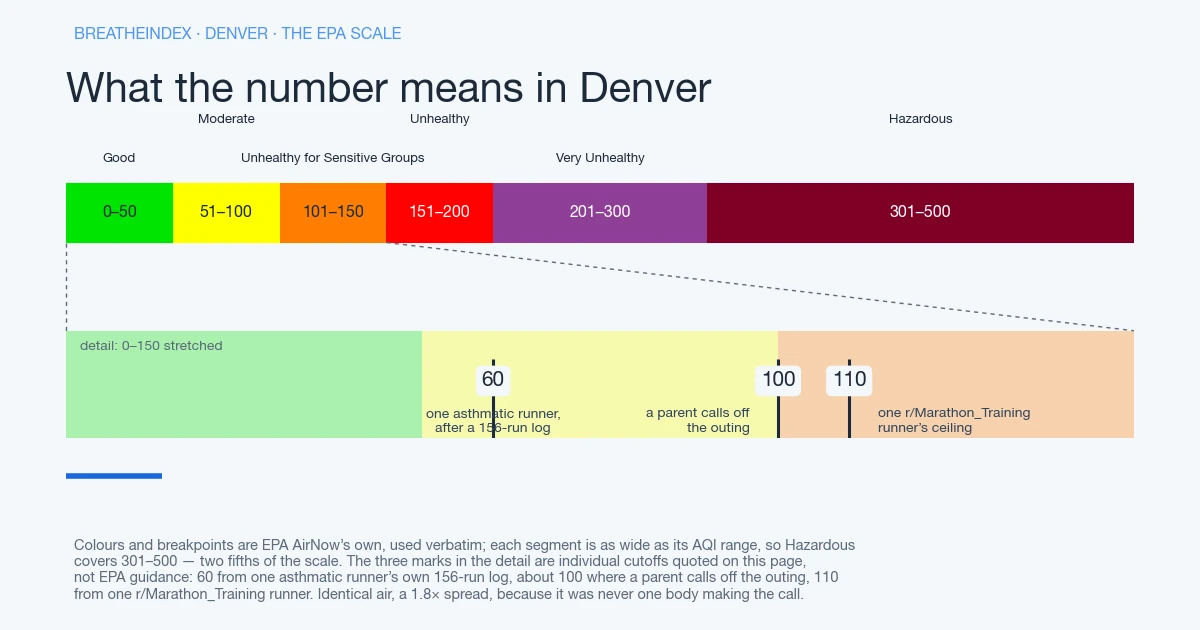
- 60 Asthmatic runnerone runner’s own 156-run log
- 75–100 Daycare / schoolparents and staff in one r/toddlers thread, Aug 2025 — not a published rule
- 100 Parentcommunity-reported, escalating at 150 and 200
- 110 Runnercommunity-reported
If you’re staying in, filter the room you’re actually in
That reading and color are today’s Denver call, nothing more. It decides the bike commute, the trail run, or the kid’s practice you’re weighing right now. BreatheCheck tracks the air quality Denver actually breathes since we began measuring here — not just the number sitting above. Skip refreshing it. Set the number that matters to you and get an email when Denver passes it.
How does today compare with Denver’s record so far?
Since 16 August 2026 we have recorded 30 days for Denver. 13 went above AQI 100, and the highest daily maximum was 156, on 27 August 2026. The day-by-day record is further down.
One reading won’t tell you if today is ordinary or a spike. Our own record, further down this page, rebuilds the air quality Denver has seen since we began measuring here, from the same hourly AQI feed as the number above.
The page also carries a running count of days above AQI 100 since we began counting. IQAir, AccuWeather, aqicn and Colorado’s own monitor grid show today’s number and nothing behind it — no shape over time. A bad Tuesday that clears by Thursday still shows up here, instead of disappearing.
Why is it hazy in Denver today?
Three things usually explain a sky that looks worse than the number reads. The AQI smooths recent hours together, weighted toward the latest, so one bad hour takes a few hours to show up in full. Smoke can also drift down from wildfires as far off as British Columbia, sitting above the ground monitor. Or the nearest station covers a different pocket of the metro.
One Denver resident described it on r/Denver: “we’re essentially sitting in a giant bowl of both high pm2.5 and high o3. A proverbial ‘double whammy’” (567 upvotes). None of that makes the haze fake. It means the reading is one day, averaged, at one place. Ozone you can’t see and haze you can covers every way the number and your senses split.
What is causing the bad air in Denver?
Two mechanisms wear the same number in Denver, on different calendars. Winter’s is the brown cloud — Denver’s old nickname for its wintertime haze. A temperature inversion traps vehicle and industrial emissions in cool air near the ground while warmer air sits above, at the foot of the Rockies. Summer runs on ozone instead, cooked out of vehicle exhaust by sunlight.
A thread titled “Denver’s infamous brown cloud looking especially crisp today” pulled 1,563 upvotes, residents supplying the mechanism themselves (300 upvotes). One reply named it precisely: a temperature inversion “traps cooler, denser air near the ground … from dissipating” (55 upvotes). Denver’s own health department says the metro is in attainment for every pollutant except one. Ozone stays “a persistent problem,” even as the brown cloud has visibly thinned since 1995. The same Denver poster named specific sources: “the lion’s share of the volatile organic compounds come from billionaire corporate polluters like Suncor, as well as upstream oil and gas operations in the Denver-Julesburg Basin” (567 upvotes). Ozone at a given AQI doesn’t look or smell like PM2.5 at that same number. It’s invisible, which is why the brown cloud sometimes takes blame it doesn’t deserve.
What makes the call different in Denver?
Denver’s geography works against it on the days PM2.5 and ozone spike together. Residents call it sitting in a bowl, and on those days the reading holds instead of clearing the way a single-pollutant afternoon usually does. Go on ordinary air. Short and unloaded: the driveway shoot-around instead of the full practice. Don’t go on a red or worse reading.
EPA marks everyone as warned starting at 151, Unhealthy. It calls 201 to 300 Very Unhealthy — a harder version of that same warning, not a new one. Past about 200, staying in isn’t a preference anymore.
What AQI should you stay inside?
Colorado’s own agencies haven’t put a number on this for schools or daycares — nothing confirmed, anyway, in what this project has reviewed. No state has, in that material — the Washington and Minnesota numbers come from people describing their own centres. Whether a documented daycare threshold exists at all covers what’s confirmed.
One Denver resident described the compound bad-air day on r/Denver, PM2.5 and ozone both spiking together: “we’re essentially sitting in a giant bowl of both high pm2.5 and high o3” (567 upvotes). Personal cutoffs don’t move together the way the pollutants do. A runner on r/Marathon_Training put theirs at 110: “I’ll run in up to 110 because…error bars.” An asthmatic runner logged 156 runs against AQI and drew a lower line, 60 — “my lungs struggle regardless of how well I’ve trained,” despite EPA calling nothing under 100 unhealthy. Their split: 87% of runs under 50 went fine, 42% between 50 and 70, just 12% past 70. Parents online tend to land near 100.
Wildfire smoke drifting down from as far as British Columbia pulls that whole table down about one EPA band on arrival. 101–150 sits in EPA’s Unhealthy for Sensitive Groups band, attributed as their wording rather than a verdict on you. Indoors, default to a portable HEPA purifier or a Corsi-Rosenthal box, priced by one community builder at $130 for a 12x14 bedroom. Skip the whole-house MERV-13 swap unless a licensed tech has checked the system’s static pressure first. Whether a purifier was money well spent takes it further.
Why our number may not match what you are seeing and smelling
This mismatch runs in reverse from smoke-aloft: normal sky, no smell, bad number anyway. Ground-level ozone — Denver’s dominant summer pollutant — is invisible and odorless, which makes it a hard sell. One person in a r/Denver ozone thread named the problem directly: “spreading awareness about ozone is tough because it’s mostly invisible and odorless.”
Telling people they’re breathing in a toxic invisible gas is a sure way to kill the vibe. But it must be done” (9 upvotes). Another commenter in the same thread pushed back on the official banding itself: “Is this 50–100 AQI really just ‘unhealthy for sensitive groups’? I’m young and fit but can feel the smoke in my eyes and throat after I’m outside for 30–60min” (163 upvotes). A clear sky and a clean nose aren’t the same test as a monitor. Ozone fails both.
Today’s reading for Denver comes from AirNow’s Denver-Boulder reporting area, whose reference point sits about 11.4 miles from the metro centre. As of .
A station miles from where you’re standing under-reports whichever side of the metro sits farthest from it, usually wherever ozone pools without a sensor nearby. Why ozone is the hardest thing on this page to measure well goes through it.
Why Denver’s air quality shifts through the year
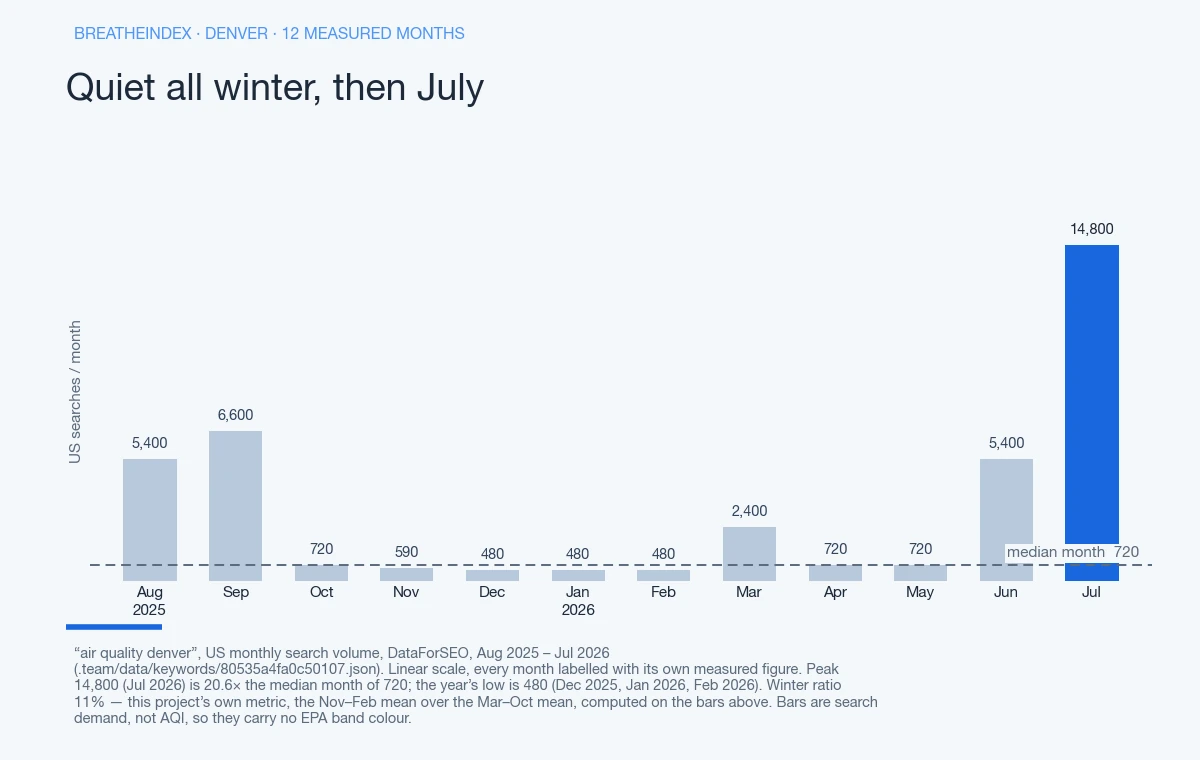
The air quality Denver sees isn’t one bad season — winter’s brown cloud and summer’s ozone trade off, and sometimes overlap. In July 2026, local coverage described Denver as briefly ranked among the most polluted major U.S. cities. Heat, wildfire smoke and ozone stacked together in the same week.
A Reddit thread on that event drew 1,290 upvotes. One resident near the foothills wrote they “can’t even see em right now” (45 upvotes), another called it “all so awful right now” (187 upvotes).
The brown cloud isn’t unique to Denver. Colorado Springs sits under the same Front Range brown cloud, and so does Fort Collins, further up the same airshed. The ozone half runs on a different map: Atlanta’s summer ozone season runs on the same sunlight-and-exhaust mechanism, and so do Houston’s, Los Angeles’s basin smog and Phoenix’s heat-cooked afternoons.
Where this number sits
Of the 121 US metros reporting to us right now, Denver is number 45 and the highest of the 4 we track in Colorado. The pollutant driving it today is O3.
Nearby metros we also measure, and what they read at the same hour:
- Boulder, CO — 24 miles away, AQI 44
- Fort Collins, CO — 59 miles away, AQI 38
- Colorado Springs, CO — 64 miles away, AQI 42
- Cheyenne, WY — 97 miles away, AQI 35
Where this reading comes from
AirNow’s Denver-Boulder reporting area, about 11.4 miles from the metro centre.
What has air quality in Denver actually been?
13 of the 30 days we have recorded so far went above AQI 100.
| Date | Daily max AQI | EPA band | Hours read |
|---|---|---|---|
| 106 | Unhealthy for Sensitive Groups | 23 | |
| 84 | Moderate | 24 | |
| 77 | Moderate | 24 | |
| 115 | Unhealthy for Sensitive Groups | 24 | |
| 117 | Unhealthy for Sensitive Groups | 24 | |
| 74 | Moderate | 24 | |
| 74 | Moderate | 24 | |
| 108 | Unhealthy for Sensitive Groups | 24 | |
| 100 | Moderate | 24 | |
| 61 | Moderate | 25 | |
| 89 | Moderate | 24 | |
| 84 | Moderate | 24 | |
| 87 | Moderate | 24 | |
| 58 | Moderate | 24 | |
| 73 | Moderate | 24 | |
| 71 | Moderate | 24 | |
| 80 | Moderate | 24 | |
| 93 | Moderate | 24 | |
| 156 | Unhealthy | 24 | |
| 140 | Unhealthy for Sensitive Groups | 24 | |
| 108 | Unhealthy for Sensitive Groups | 24 | |
| 122 | Unhealthy for Sensitive Groups | 24 | |
| 93 | Moderate | 24 | |
| 93 | Moderate | 24 | |
| 108 | Unhealthy for Sensitive Groups | 24 | |
| 108 | Unhealthy for Sensitive Groups | 24 | |
| 119 | Unhealthy for Sensitive Groups | 24 | |
| 105 | Unhealthy for Sensitive Groups | 24 | |
| 97 | Moderate | 27 | |
| 108 | Unhealthy for Sensitive Groups | 13 — partial day |
Questions about Denver
What is the air quality in Denver right now?
Which monitor does this number come from?
How does Denver compare with metros nearby?
Does this include pollen?
Put this number in context
Updated