
Right now: Fort Collins is at 38, good.
Is the air safe to breathe in Fort Collins today?
In Fort Collins, BreatheCheck reads 38 as Go. The cutoffs: go below 101, keep it short and easy from 101 to 150, move it indoors above 150. These are our own thresholds, drawn on the EPA bands — EPA itself classifies 101–150 as Unhealthy for Sensitive Groups and does not tell you how long to stay out.
Go AQI 0–100
Normal outdoor plans. No change needed.
Short & unloaded AQI 101–150
A 20-minute dog walk, not a 2.5-hour run. Keep it brief and easy.
Don’t go AQI 151+
Move it indoors. Above 200 that becomes everyone, not just sensitive groups.
Above 200 this stops being a personal call: everyone indoors.
Duration and intensity are two separate dials
| Under 20 min | 20–60 min | Over an hour | |
|---|---|---|---|
| Easy | Go | Go | Go |
| Moderate | Go | Go | Go |
| Hard | Go | Go | Go |
Go Every combination lands the same way at this reading — a hard hour is no different from an easy twenty minutes. The two dials separate above 80.
Where people actually draw the line
All the thresholds people reported, and who reported them
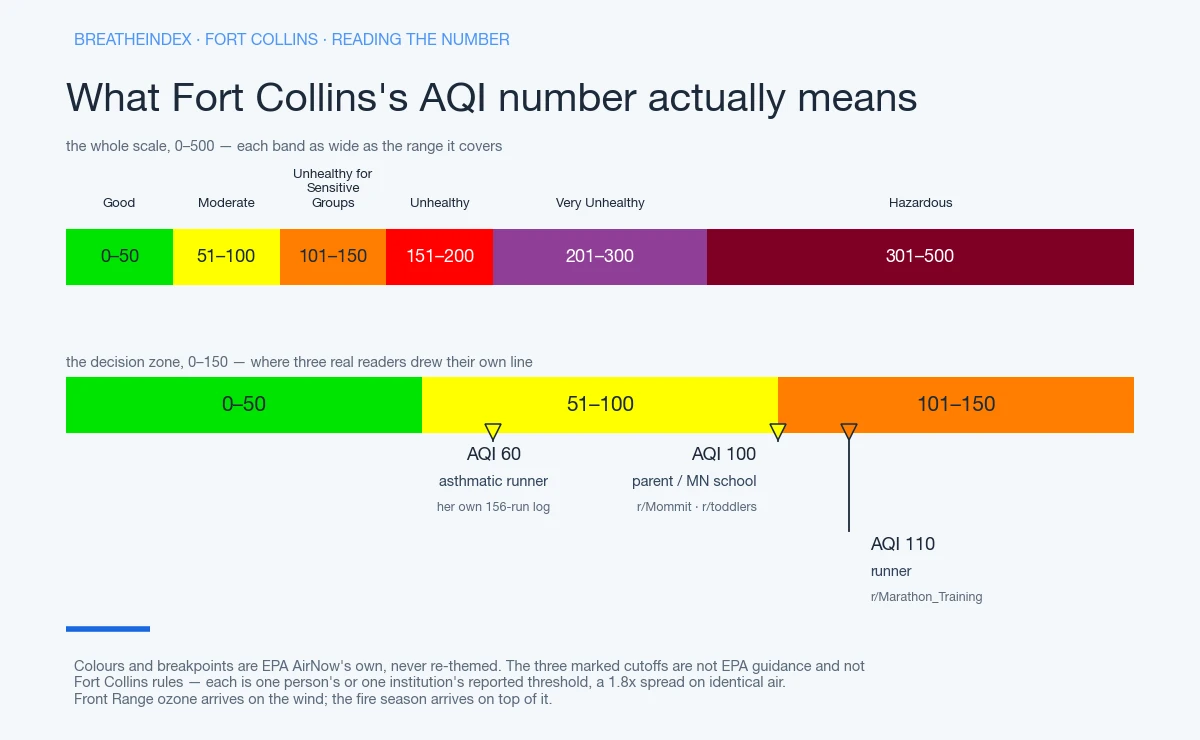
- 60 Asthmatic runnerone runner’s own 156-run log
- 75–100 Daycare / schoolparents and staff in one r/toddlers thread, Aug 2025 — not a published rule
- 100 Parentcommunity-reported, escalating at 150 and 200
- 110 Runnercommunity-reported
If you’re staying in, filter the room you’re actually in
Fort Collins gets its own reading up there. It isn’t a number borrowed from Denver, 65 miles south. The air quality Fort Collins breathes runs on its own two-season calendar, covered below. The color decides something specific — the Horsetooth trail run, the CSU tailgate, whether tonight’s the night the windows stay open. BreatheCheck tracks what Fort Collins itself has breathed since we began measuring here, not just the figure sitting above. Pick your own threshold and let the alert do the refreshing.
How does today compare with Fort Collins’s record so far?
Since 16 August 2026 we have recorded 30 days for Fort Collins. 0 went above AQI 100, and the highest daily maximum was 87, on 20 August 2026. The day-by-day record is further down.
A single number can’t say whether today is a blip or the start of a run of bad days. Our own record, further down this page, rebuilds the air quality Fort Collins has actually seen since we began measuring here.
It pulls from the same hourly AQI feed as the number above. A running count tracks days above AQI 100 since we began counting. IQAir, AccuWeather, aqicn and Colorado’s own monitor grid all stop at today’s figure. None of them render the shape behind it. Up here, shape matters more than in most cities on this list. Fort Collins runs on two separate calendars — a wintertime particulate stretch (PM2.5 and PM10 both) and a summer ozone stretch. They don’t look anything alike side by side.
Why is it hazy in Fort Collins today?
Three explanations cover most hazy-but-moderate days. Smoothing across recent hours can hold back one rough hour. Smoke can sit aloft above the monitor, or a station can stand in for a stretch of city it isn’t next to. Fort Collins adds a fourth, regional one. Colorado’s Regional Air Quality Council issues a single Front Range Ozone Action Day alert covering the whole corridor at once, not city by city.
That corridor covers Fort Collins, Denver and Colorado Springs at once, and the ozone driving it doesn’t stop at a city limit either. The day’s forecast on AirNow shows whether one is in effect right now. None of that makes a hazy sky here fake. It means the reading is one average, from one station, standing in for a corridor running more than 100 miles north to south. Winter particulate, summer ozone, and the gap between them covers the general case.
What is causing the bad air in Fort Collins?
The same number gets worn by winter and by summer here, on two different calendars, and neither one starts in Fort Collins. Winter’s version drifts up from the brown cloud, Denver’s decades-old nickname for its own wintertime haze. Cold air traps vehicle and industrial emissions along the length of the Front Range. Summer’s version, ground-level ozone, matters more up here, cooked from vehicle exhaust and Denver-Julesburg Basin oil-and-gas emissions.
That ozone can form well south of the city and drift north on an ordinary afternoon wind, before Fort Collins ever measures it. No Fort Collins-specific community thread describing either mechanism turned up in the material reviewed. The corpus for this city is thinner than for Denver or Colorado Springs — a gap worth stating rather than papered over with borrowed detail. Denver’s own residents describe the brown cloud and the ozone in more first-hand detail than this page can for Fort Collins specifically.
What makes the call different in Fort Collins?
A single Front Range Ozone Action Day can cover Fort Collins, Denver and Colorado Springs at once. It’s issued for the whole corridor, not any one city. It can run a step ahead of, or behind, what Fort Collins is reading right now, so check the local number first. Go on a normal reading. Short and unloaded: the short bike commute instead of the group ride out toward Horsetooth.
Don’t go once the number climbs into the red. EPA opens its everyone-warning at 151, Unhealthy. It treats 201 to 300, Very Unhealthy, as that same warning at a more serious stage — not a separate group. Above roughly 200, the corridor alert and the local reading agree on one thing: stay in.
What AQI should you stay inside?
Nothing turned up for a Colorado school or daycare AQI rule in the material this project has reviewed. The Washington and Minnesota numbers people cite are individual accounts of single centres, not state rules. Which states put a number in writing has what’s confirmed.
The Front Range’s shared Ozone Action Day alert says nothing about where an individual’s own threshold sits. That’s a personal number, and it runs well under the EPA’s single sensitive-groups line. “I’ll run in up to 110 because…error bars,” a runner on r/Marathon_Training wrote, naming their own ceiling. An asthmatic runner logged 156 runs against AQI instead and set a lower one, 60. Past it, “my lungs struggle regardless of how well I’ve trained,” despite EPA calling nothing under 100 unhealthy. Their log: 87% of runs under 50 went fine, 42% between 50 and 70, just 12% past 70. Parents online land closer to 100.
Wildfire smoke pulls that whole table down further still, roughly one EPA band, layered on top of whatever the ozone corridor is already doing. EPA’s own name for that stretch is 101–150, Unhealthy for Sensitive Groups — attributed, and not aimed at any one reader. Indoors, default to a portable HEPA purifier or a Corsi-Rosenthal box; one builder priced a 12x14 bedroom’s worth at $130. Skip the whole-house MERV-13 swap unless a licensed tech has checked the system’s static pressure first. Monitor first, purifier second, filter third explains why.
Why our number may not match what you are seeing and smelling
The mismatch runs in two directions here, and the second one is the harder sell. A hazy sky with a moderate number is usually smoothing across recent hours, or a station standing in for the wrong stretch of the corridor. A clear, still summer afternoon can look like the best day of the week and still carry a triple-digit reading. Ground-level ozone is invisible and odorless.
There’s no smelling your way to a safe read on it. Fort Collins sits at the north end of a corridor built around that exact mismatch. It’s the whole reason the region issues one shared ozone alert instead of 28 separate ones.
Today’s reading for Fort Collins comes from AirNow’s Fort Collins reporting area, whose reference point sits about 6.7 miles from the metro centre. As of .
A station standing in for a smaller city like this one carries a wider margin than one covering a dense urban core. Why a smaller city’s station carries a wider margin explains the arithmetic.
Fort Collins shares a corridor, not a copy
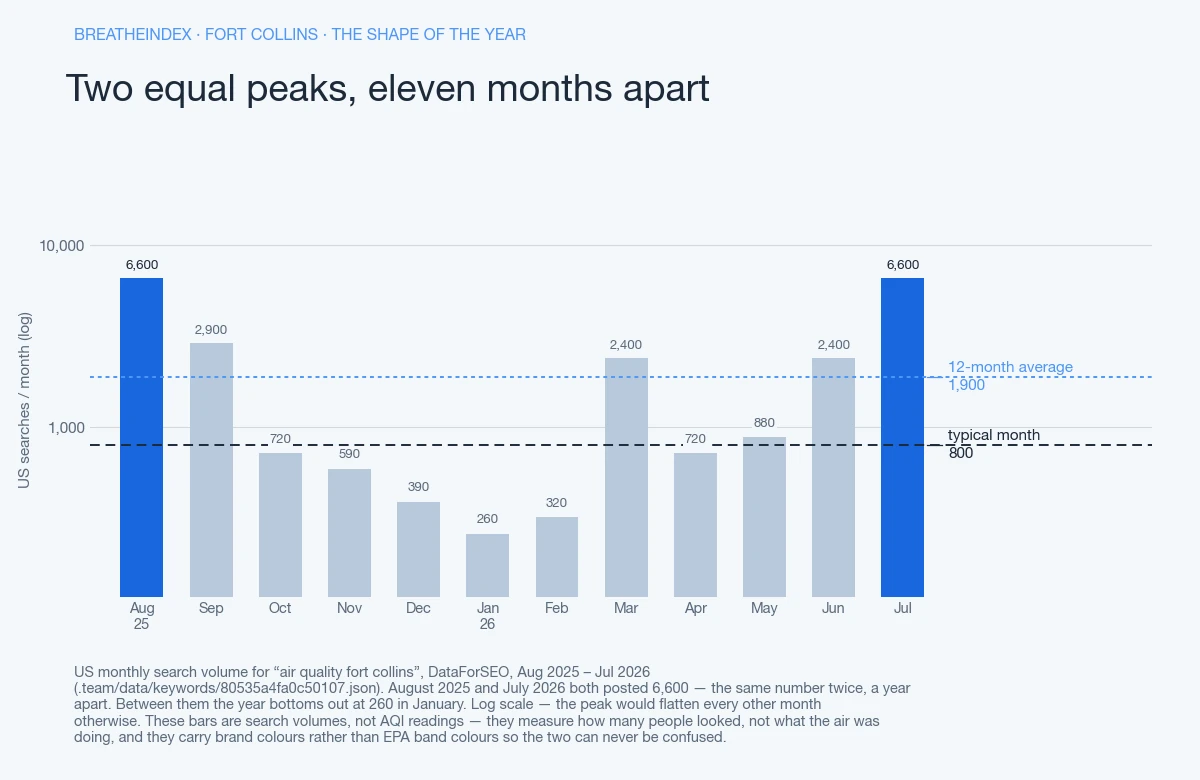
Search interest here tracks the same two-season pattern as the own history: a winter particulate stretch, then a summer ozone stretch, not one clean peak. What makes Fort Collins different from its Front Range neighbors isn’t the mechanism — it’s the distance.
Denver carries the region’s brown-cloud history and its own ozone-source detail. Colorado Springs sits under the same alert system, from the south end of the corridor. Fort Collins is the north end of the same airshed. It’s genuinely thinner on its own first-hand community record, and that gap is stated here rather than papered over with borrowed detail.
Where this number sits
Of the 121 US metros reporting to us right now, Fort Collins is number 65 and number 4 of the 4 we track in Colorado. The pollutant driving it today is O3.
Nearby metros we also measure, and what they read at the same hour:
- Cheyenne, WY — 40 miles away, AQI 35
- Boulder, CO — 41 miles away, AQI 44
- Denver, CO — 59 miles away, AQI 44
- Colorado Springs, CO — 122 miles away, AQI 42
Where this reading comes from
AirNow’s Fort Collins reporting area, about 6.7 miles from the metro centre.
What has air quality in Fort Collins actually been?
0 of the 30 days we have recorded so far went above AQI 100.
| Date | Daily max AQI | EPA band | Hours read |
|---|---|---|---|
| 71 | Moderate | 23 | |
| 71 | Moderate | 24 | |
| 49 | Good | 24 | |
| 77 | Moderate | 24 | |
| 80 | Moderate | 24 | |
| 51 | Moderate | 24 | |
| 54 | Moderate | 24 | |
| 67 | Moderate | 24 | |
| 67 | Moderate | 24 | |
| 50 | Good | 23 | |
| 49 | Good | 24 | |
| 67 | Moderate | 24 | |
| 54 | Moderate | 24 | |
| 47 | Good | 23 | |
| 50 | Good | 23 | |
| 51 | Moderate | 24 | |
| 58 | Moderate | 24 | |
| 64 | Moderate | 23 | |
| 80 | Moderate | 24 | |
| 87 | Moderate | 24 | |
| 71 | Moderate | 24 | |
| 80 | Moderate | 24 | |
| 61 | Moderate | 23 | |
| 80 | Moderate | 24 | |
| 84 | Moderate | 24 | |
| 87 | Moderate | 24 | |
| 77 | Moderate | 23 | |
| 80 | Moderate | 24 | |
| 80 | Moderate | 26 | |
| 84 | Moderate | 13 — partial day |
Questions about Fort Collins
What is the air quality in Fort Collins right now?
Which monitor does this number come from?
How does Fort Collins compare with metros nearby?
Does this include pollen?
Put this number in context
Updated