
Right now: Eugene is at 28, good.
Is the air safe to breathe in Eugene today?
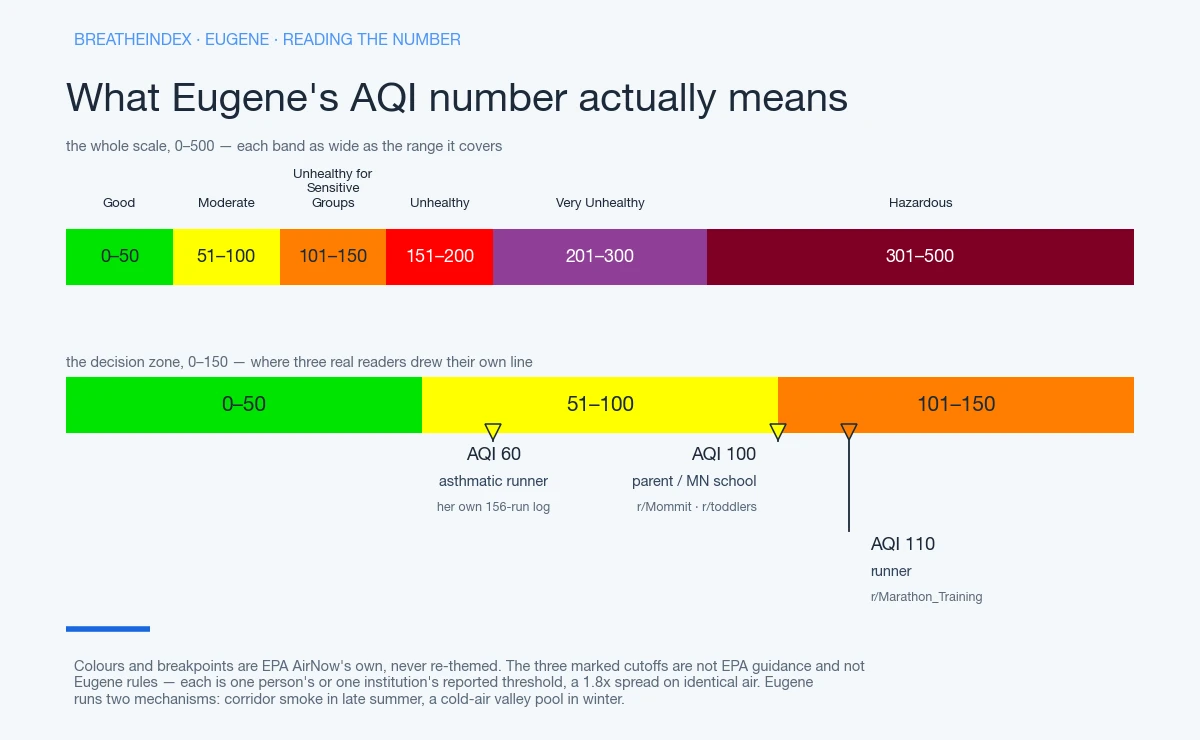
In Eugene, BreatheCheck reads 28 as Go. The cutoffs: go below 101, keep it short and easy from 101 to 150, move it indoors above 150. These are our own thresholds, drawn on the EPA bands — EPA itself classifies 101–150 as Unhealthy for Sensitive Groups and does not tell you how long to stay out.
Go AQI 0–100
Normal outdoor plans. No change needed.
Short & unloaded AQI 101–150
A 20-minute dog walk, not a 2.5-hour run. Keep it brief and easy.
Don’t go AQI 151+
Move it indoors. Above 200 that becomes everyone, not just sensitive groups.
Above 200 this stops being a personal call: everyone indoors.
Duration and intensity are two separate dials
| Under 20 min | 20–60 min | Over an hour | |
|---|---|---|---|
| Easy | Go | Go | Go |
| Moderate | Go | Go | Go |
| Hard | Go | Go | Go |
Go Every combination lands the same way at this reading — a hard hour is no different from an easy twenty minutes. The two dials separate above 80.
Where people actually draw the line
All the thresholds people reported, and who reported them
- 60 Asthmatic runnerone runner’s own 156-run log
- 75–100 Daycare / schoolparents and staff in one r/toddlers thread, Aug 2025 — not a published rule
- 100 Parentcommunity-reported, escalating at 150 and 200
- 110 Runnercommunity-reported
If you’re staying in, filter the room you’re actually in
That color and number are today’s read on Eugene air quality. What they’re actually deciding is smaller than the headline: the trail run up Spencer Butte, the kid’s soccer practice, whether the windows stay open tonight. BreatheCheck tracks the air quality Eugene has actually breathed since we began measuring here, not just the one figure updating above. Skip the refreshing — an email when the valley fills up is the cheaper habit.
How does today compare with Eugene’s record so far?
Since 16 August 2026 we have recorded 30 days for Eugene. 2 went above AQI 100, and the highest daily maximum was 169, on 1 September 2026. The day-by-day record is further down.
One reading says nothing about the shape behind it. BreatheCheck rebuilds the air quality Eugene has seen since we began measuring here, from the same hourly AQI feed as the number above.
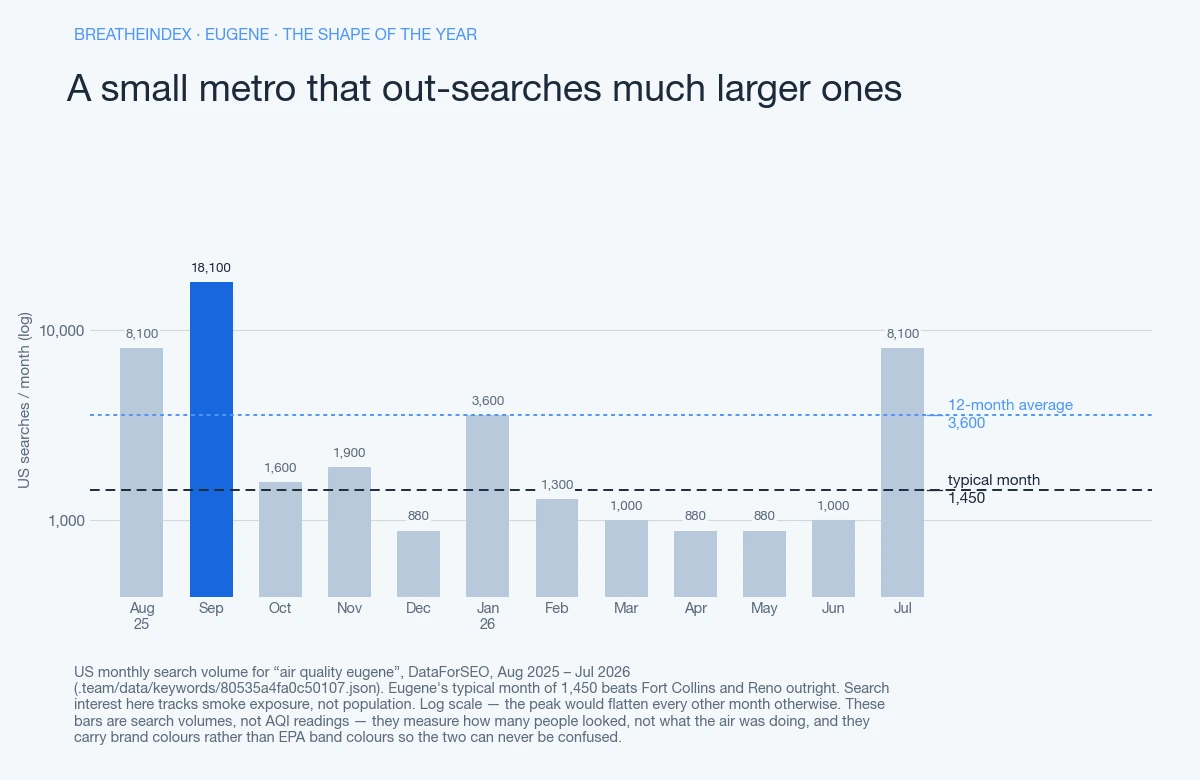
The page also carries a running count of days above AQI 100 since we began counting. IQAir and AccuWeather hand you today’s number and stop there. Neither tells you whether today is a typical week or the one loud stretch a year. Eugene runs a median month of just 1,450 searches for its own air quality. Metros many times its size run fewer.
Why is it hazy in Eugene today?
Three things can make Eugene’s sky look worse than the number suggests. The AQI smooths recent hours together, weighted toward the latest, which means a rough afternoon takes time to show up in full. Smoke can sit aloft above the ground-level monitor, or the nearest station can sit miles off. Eugene sits at the south end of the Pacific Northwest smoke corridor, so its plume usually arrives later and thinner than in Seattle or Spokane.
A commenter on r/Seattle summed up that gap during one regional smoke event: “Air sensor on ground, smoke up high (for now).” Another reply on the same thread put it shorter: “Sky biiiig, smoke faaar.” None of that makes the haze fake. Smoke aloft, a valley lid, an averaged reading goes through each cause.
What is causing the bad air in Eugene?
Wildfire smoke drifting down from British Columbia, eastern Washington and Oregon’s own fire season is Eugene’s main driver. Fine particulate matter (PM2.5) from burning vegetation dominates most bad-air days. A second, smaller mechanism runs in winter. Eugene sits in the Willamette Valley, a basin that can trap cold air and hold wood smoke close to the ground on a still night.
That’s the same kind of pooling that traps pollution in a mountain valley elsewhere, just gentler here, and a minor contributor next to fire season, not the dominant one. No Eugene-specific community account of either mechanism turned up in the material reviewed for this page — the smoke-corridor vernacular quoted above describes a commenter’s own account in Seattle, not an Eugene resident.
What makes the call different in Eugene?
Eugene’s air is safe on Good or Moderate readings. Go, or keep it short and unloaded — the short loop up Spencer Butte instead of the summit push. Don’t go once the color passes that. EPA’s everyone-warning opens at 151, Unhealthy. 201 to 300, Very Unhealthy, is the same warning at a harsher level, not a wider group.
Eugene sits at the tail end of the Pacific Northwest smoke corridor that also runs through Seattle and Spokane. A plume usually reaches here later, and thinner, than it hit those cities first — which is why checking today’s own number matters more than trusting yesterday’s Seattle headline. Past roughly 200, indoor plans aren’t optional, whatever cleared through Seattle the day before.
What AQI should you stay inside?
Smoke reaching Eugene has usually already thinned by the time it clears Seattle and Spokane further north. That lag pulls personal thresholds down roughly one EPA band, the same direction wildfire smoke pulls thresholds anywhere. EPA calls 101–150 Unhealthy for Sensitive Groups — the agency’s category, not a personal ruling.
A commenter on r/Seattle summed up the aloft gap during one regional event: “Air sensor on ground, smoke up high (for now).”
Oregon has no published school or daycare AQI cutoff in what this project has reviewed. Washington’s applies just north of here, not in Oregon; Minnesota’s is the other documented one. The two centre-level numbers, and why neither is a state rule covers both.
Individual numbers vary widely regardless of source. “I’ll run in up to 110 because…error bars,” wrote one r/Marathon_Training runner. An asthmatic runner logged 156 runs against AQI instead and found a lower wall, 60 — “my lungs struggle regardless of how well I’ve trained,” even though EPA calls nothing under 100 unhealthy. Their own numbers: 87% of runs under 50 went fine, 42% between 50 and 70, just 12% past 70. Parents online tend to land near 100.
Indoors, default to a portable HEPA purifier or a Corsi-Rosenthal box; one builder priced a 12x14 bedroom version at $130. A whole-house MERV-13 swap needs a static-pressure check from a licensed tech first. Filter ratings, box fans and what they can’t fix covers the rest.
Why our number may not match what you are seeing and smelling
The mismatch between Eugene’s sky and its number runs two directions. A smoky sky with a calm number usually means smoke sitting aloft above the monitor, or smoothing across recent hours holding back a rough afternoon. A clear, still day with a moderate reading usually means ground-level ozone, formed when sunlight cooks vehicle exhaust — invisible and odorless. Neither direction means the number is wrong; it means the number and the senses are measuring different things.
It’s the same gap the r/Seattle commenters described, just one region over. One commenter on r/Denver flagged the identical blind spot: “spreading awareness about ozone is tough because it’s mostly invisible and odorless. Telling people they’re breathing in a toxic invisible gas is a sure way to kill the vibe. But it must be done!”
Today’s reading for Eugene comes from AirNow’s Eugene and Springfield reporting area, whose reference point sits about 1.7 miles from the metro centre. As of .
A station miles off under-reports whichever side of the valley sits farthest from it. How far a single valley station can be trusted is set out in full.
Why smoke, not city size, decides who watches the air here
Smoke exposure, not population, predicts search interest for air quality Eugene. Wenatchee, Washington — population roughly 35,000 — pulls more than double Atlanta’s search volume for the identical query, despite a metro roughly 180 times smaller. Eugene’s own median month, 1,450, beats Fort Collins’s 810 and Reno’s 800 on the same logic. Eugene sits at the southern edge of the same Pacific Northwest smoke corridor that reaches Seattle and Spokane first.
The same plumes reach Eugene too, arriving later and usually thinner. Boise, on the opposite side of the corridor, catches many of the same regional fires. None of the three shares Eugene’s second mechanism: a valley basin that can pool cold air and wood smoke through a still winter night.
Where this number sits
Of the 121 US metros reporting to us right now, Eugene is number 97 and the highest of the 2 we track in Oregon. The pollutant driving it today is PM2.5.
Nearby metros we also measure, and what they read at the same hour:
- Portland, OR — 104 miles away, AQI 26
- Seattle, WA — 249 miles away, AQI 37
- Boise, ID — 345 miles away, AQI 32
- Reno, NV — 355 miles away, AQI 43
Where this reading comes from
AirNow’s Eugene and Springfield reporting area, about 1.7 miles from the metro centre.
What has air quality in Eugene actually been?
2 of the 30 days we have recorded so far went above AQI 100.
| Date | Daily max AQI | EPA band | Hours read |
|---|---|---|---|
| 43 | Good | 23 | |
| 37 | Good | 24 | |
| 43 | Good | 24 | |
| 67 | Moderate | 24 | |
| 54 | Moderate | 24 | |
| 52 | Moderate | 24 | |
| 53 | Moderate | 24 | |
| 42 | Good | 24 | |
| 28 | Good | 24 | |
| 33 | Good | 23 | |
| 28 | Good | 24 | |
| 28 | Good | 24 | |
| 27 | Good | 24 | |
| 169 | Unhealthy | 23 | |
| 165 | Unhealthy | 24 | |
| 30 | Good | 24 | |
| 28 | Good | 24 | |
| 28 | Good | 24 | |
| 27 | Good | 24 | |
| 28 | Good | 24 | |
| 70 | Moderate | 24 | |
| 83 | Moderate | 24 | |
| 22 | Good | 23 | |
| 48 | Good | 24 | |
| 56 | Moderate | 24 | |
| 61 | Moderate | 24 | |
| 60 | Moderate | 24 | |
| 58 | Moderate | 24 | |
| 55 | Moderate | 27 | |
| 53 | Moderate | 13 — partial day |
Questions about Eugene
What is the air quality in Eugene right now?
Which monitor does this number come from?
How does Eugene compare with metros nearby?
Does this include pollen?
Put this number in context
Updated