
Right now: Seattle is at 37, good.
Is the air safe to breathe in Seattle today?
In Seattle, BreatheCheck reads 37 as Go. The cutoffs: go below 101, keep it short and easy from 101 to 150, move it indoors above 150. These are our own thresholds, drawn on the EPA bands — EPA itself classifies 101–150 as Unhealthy for Sensitive Groups and does not tell you how long to stay out.
Go AQI 0–100
Normal outdoor plans. No change needed.
Short & unloaded AQI 101–150
A 20-minute dog walk, not a 2.5-hour run. Keep it brief and easy.
Don’t go AQI 151+
Move it indoors. Above 200 that becomes everyone, not just sensitive groups.
Above 200 this stops being a personal call: everyone indoors.
Duration and intensity are two separate dials
| Under 20 min | 20–60 min | Over an hour | |
|---|---|---|---|
| Easy | Go | Go | Go |
| Moderate | Go | Go | Go |
| Hard | Go | Go | Go |
Go Every combination lands the same way at this reading — a hard hour is no different from an easy twenty minutes. The two dials separate above 80.
Where people actually draw the line
All the thresholds people reported, and who reported them
- 60 Asthmatic runnerone runner’s own 156-run log
- 75–100 Daycare / schoolparents and staff in one r/toddlers thread, Aug 2025 — not a published rule
- 100 Parentcommunity-reported, escalating at 150 and 200
- 110 Runnercommunity-reported
If you’re staying in, filter the room you’re actually in
That color and that number are today’s read on air quality Seattle residents are breathing right now. What matters more is the walk, the run, or the kid’s recess you’re deciding. Here, the number and the sky don’t always agree. Skip refreshing it. Set your own threshold and hear about smoke season starting without checking.
How does today compare with Seattle’s record so far?
Since 16 August 2026 we have recorded 30 days for Seattle. 0 went above AQI 100, and the highest daily maximum was 95, on 10 September 2026. The day-by-day record is further down.
One reading tells you nothing about the pattern behind it. BreatheCheck tracks the air quality Seattle actually saw since we began measuring here, rebuilt from the same hourly AQI feed as the number above.
The page also carries a count of days above AQI 100 since we began counting. IQAir, AccuWeather, aqicn and the state’s monitor grid all give today’s number and nothing behind it — none show a metro’s actual shape over time. A quiet stretch that suddenly spikes once smoke rolls in still counts here. It doesn’t vanish the way it does on a page that only shows “now.”
Why is it hazy in Seattle today?
On August 13, 2026, a photo from a parking structure in Bellevue — sun bright red, sky thick with haze — went up on r/Seattle. It carried one question: “How is this 30 AQI?” The post pulled 734 upvotes. The top reply, 949 upvotes, gave the answer this page is built around: “Air sensor on ground, smoke up high (for now).” Shorter, from another: “Sky biiiig, smoke faaar” (354 upvotes).
Smoke commonly sits aloft, a few thousand feet up, above the ground-level monitor actually breathing your air. One reply linked a live smoke plume forecast and called it, simply, “Smoke aloft mostly” (261 upvotes). It doesn’t always stay odor-free up there — one commenter flagged the mismatch: “Strange part is that it smells rather strongly of smoke. Usually when it stays aloft I don’t notice an aroma” (254 upvotes). Another guessed at the nose’s math: “human noses can detect smoke at less than 1ppm. AQI of 30 probably means around 7–10 PPM of smoke pollution” (131 upvotes) — their own estimate, not an EPA figure.
The nearest working station can also be miles off. One reply named it: “IQAir sensor seems to be sourcing from Auburn that was green, while eastside was already 100+” (18 upvotes). None of that makes the haze fake. It means the number is one reading, averaged at one location, not a live photo of your street. Smoke aloft and a number that stays calm underneath it works through the general case.
What is causing the bad air in Seattle?
Two sources drive most of Seattle’s bad-air days. Neither is a valley trapping cold air the way mountain-ringed cities do. Puget Sound sits open to onshore marine flow most of the year. That’s part of why baseline air here often reads cleaner than Denver’s or Salt Lake City’s. What breaks that is wildfire smoke, drifting in from British Columbia and Eastern Washington.
That smoke is mostly fine particulate matter (PM2.5), not the coarser PM10 dust of dust-storm cities. Wind pushes it here; no local inversion traps it. Locals name the season it arrives in: smoke season. One commenter warned a first-time visitor: “In 2 months it will dry out, the green will fade, lawns will turn brown, the flowers will fall, and the smoke and dust will come” (159 upvotes).
Marine air moving back in usually clears it — the regional equivalent of a storm breaking an inversion elsewhere. One 2017 thread put it plainly: “It’s noticeably clearer this morning and the air smells fresher. Thank goodness it’s finally gone” (52 upvotes). Ground-level ozone can also push the number up on a hot, clear afternoon. It’s invisible, odorless and unrelated to smoke. That mechanism is generic, covered in full on the AQI scale explained.
What makes the call different in Seattle?
Seattle now runs on a named “smoke season,” a stretch locals plan around the way other cities plan around rain. That’s separate from the everyday gap between a hazy sky and a calm number. Go on Good or Moderate air, nothing to adjust. Short and unloaded: the elevator-adjacent errand instead of the long walk downtown. Don’t go past that.
Whichever is driving today’s read, the call underneath is the same three options. EPA’s warning to everyone opens at 151, Unhealthy. 201 to 300, Very Unhealthy, is that same warning at a harder level, not a new group. Past roughly 200, smoke season or not, the plan moves indoors.
What AQI should you stay inside?
Washington is one of only two states with a documented daycare or school AQI threshold. A Washington teacher on r/toddlers named a hard ceiling: “we usually have all kids stay inside if the air quality reaches over 75. 80 is the absolute limit.”
A Washington parent, same thread, put the daycare number at 80, “I think” — both below Minnesota’s reported school line of 100. A Washington teacher’s school stopping outdoor time at 75 covers what’s confirmed; neither is checked against regulation text.
Smoke season pulls the whole personal-threshold table down further, and Seattle hits that gap harder than most tracked metros. “Smoke at AQI 50 feels way worse than pollution at AQI 50,” one commenter wrote. EPA’s own wording for that band is 101–150, Unhealthy for Sensitive Groups — a category, not a judgment on any one reader.
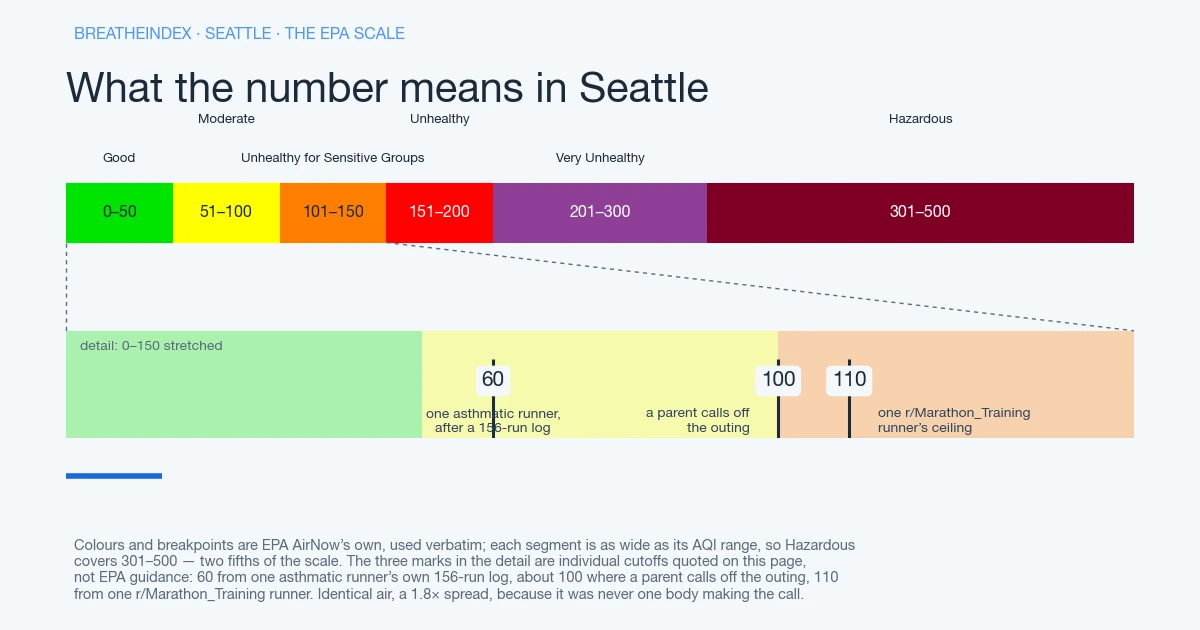
Individual cutoffs still sit well below either institutional number. A runner on r/Marathon_Training: “I’ll run in up to 110 because…error bars.” One asthmatic runner logged 156 runs and found their own cutoff at 60 — “my lungs struggle regardless of how well I’ve trained,” though EPA calls nothing under 100 unhealthy. Their log: 87% of runs under AQI 50 went fine, 42% between 50–70, just 12% above 70. Parents online land closer to 100.
Indoors, default to a portable HEPA purifier or a Corsi-Rosenthal box — a DIY build one member put at around $130 for a 12x14 bedroom. A whole-house MERV-13 swap isn’t the default; it can restrict airflow enough to make an AC struggle, and the safe version needs a static-pressure check from a licensed tech first. The indoor kit for a smoke week covers the rest.
Why our number may not match what you are seeing and smelling
The mismatch cuts both directions here, and the second is the trap nobody warns about. A hazy sky with a quiet number is direction one — the everyday smoke-aloft gap. Direction two runs opposite: a clear sky, no campfire smell, and a number that’s still bad, usually because ground-level ozone is invisible and odorless.
One Denver resident who hit the same trap: “Spreading awareness about ozone is tough because it’s mostly invisible and odorless.” A parent stuck home with a toddler in Brooklyn described the identical gap. “My husband keeps saying it seems fine, it looks clear outside and doesn’t smell bad but I feel like all the harmful stuff is invisible.” Neither is describing Seattle — the mechanism is generic.
Today’s reading for Seattle comes from AirNow’s Seattle-Bellevue-Kent Valley reporting area, whose reference point sits about 3.4 miles from the metro centre. As of .
A station miles off under-reports whichever side of the metro sits farthest from it — the Eastside-versus-Auburn split above is exactly this problem. Why an Eastside-versus-Auburn split shows up in one number explains the mechanics.
Why Seattle gets “smoke season”
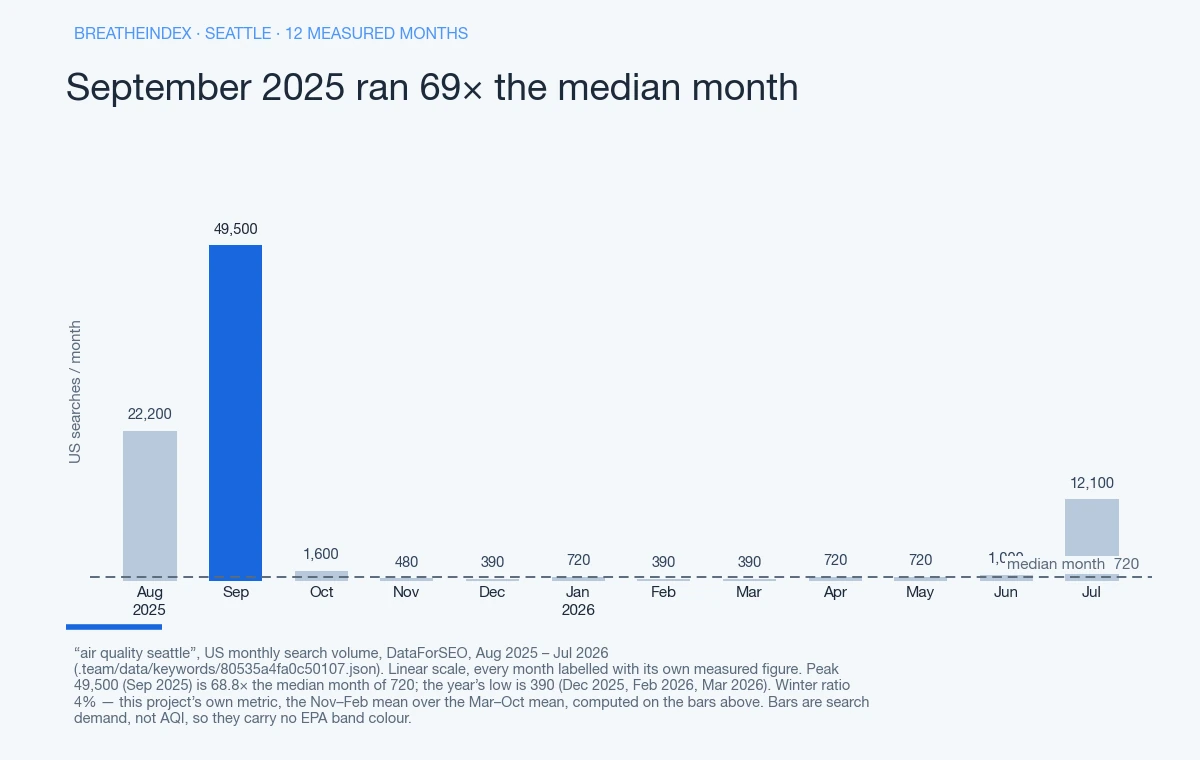
Search interest in air quality Seattle and the AQI itself spike on the same calendar: a late-summer one, not the winter pattern mountain-ringed cities get. Locals don’t reach for “wildfire season” — the shorthand is smoke season. A hazy sky with a quiet number is smoke season’s signature trick. The sensor usually catches up only after the sky already told you something was wrong.
One widely-read 2022 post (2,133 upvotes) put how normal it’s become in its own words. “This has happened in 3 out of the last 5 years. Smoke so bad that we were wearing respirators pre-covid. We are talking less than a mile of visibility.”
The corridor isn’t unique to Seattle. Spokane sits in the same Pacific Northwest smoke path, and Eugene at the southern end and Boise on the inland side both take smoke from the same regional fires, on different days.
Where this number sits
Of the 121 US metros reporting to us right now, Seattle is number 68 and the highest of the 2 we track in Washington. The pollutant driving it today is PM2.5.
Nearby metros we also measure, and what they read at the same hour:
- Portland, OR — 145 miles away, AQI 26
- Spokane, WA — 228 miles away, AQI 34
- Eugene, OR — 249 miles away, AQI 28
- Missoula, MT — 394 miles away, AQI 21
Where this reading comes from
AirNow’s Seattle-Bellevue-Kent Valley reporting area, about 3.4 miles from the metro centre.
What has air quality in Seattle actually been?
0 of the 30 days we have recorded so far went above AQI 100.
| Date | Daily max AQI | EPA band | Hours read |
|---|---|---|---|
| 50 | Good | 23 | |
| 58 | Moderate | 24 | |
| 61 | Moderate | 24 | |
| 54 | Moderate | 24 | |
| 95 | Moderate | 24 | |
| 83 | Moderate | 24 | |
| 61 | Moderate | 24 | |
| 54 | Moderate | 24 | |
| 54 | Moderate | 24 | |
| 69 | Moderate | 25 | |
| 56 | Moderate | 24 | |
| 53 | Moderate | 24 | |
| 39 | Good | 24 | |
| 59 | Moderate | 24 | |
| 56 | Moderate | 24 | |
| 54 | Moderate | 24 | |
| 36 | Good | 24 | |
| 33 | Good | 23 | |
| 38 | Good | 24 | |
| 63 | Moderate | 24 | |
| 65 | Moderate | 24 | |
| 46 | Good | 24 | |
| 44 | Good | 24 | |
| 57 | Moderate | 24 | |
| 61 | Moderate | 24 | |
| 56 | Moderate | 24 | |
| 58 | Moderate | 24 | |
| 64 | Moderate | 24 | |
| 55 | Moderate | 27 | |
| 24 | Good | 13 — partial day |
Questions about Seattle
What is the air quality in Seattle right now?
Which monitor does this number come from?
How does Seattle compare with metros nearby?
Does this include pollen?
Put this number in context
Updated